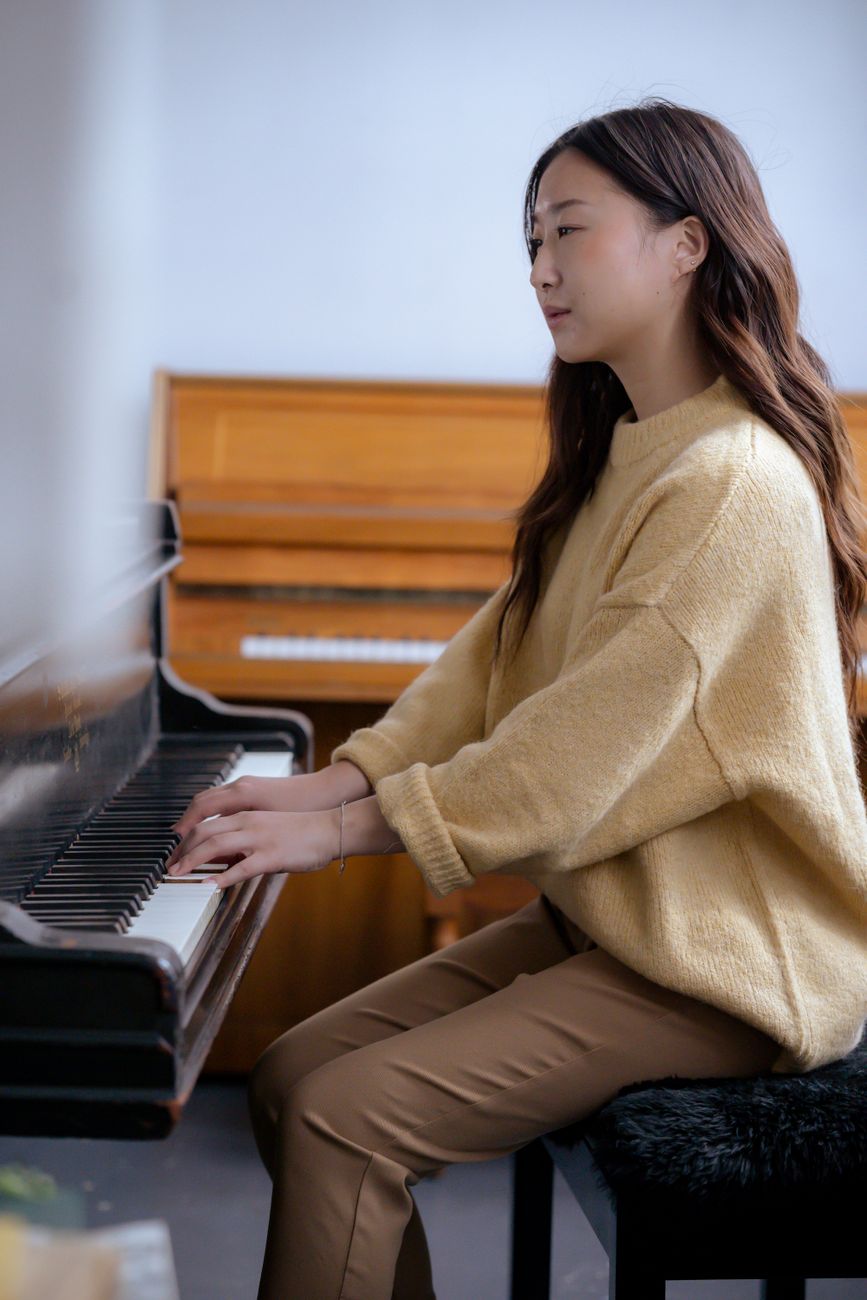
The Connection Between Mental Clarity and Physical Freedom
Many pianists experience physical tension when they play. Their shoulders rise, their wrists become stiff, their fingers tighten, or their breathing becomes shallow.
When this happens, the usual advice is to relax.
But what does it actually mean to relax? And why is it so difficult to do so, even when we consciously try?
Through my own experience as a pianist and my years of teaching, I have come to recognize that physical tension sometimes begins long before a finger touches the keyboard.
It begins with uncertainty in the mind.
The Body Responds to What the Mind Does Not Know
Imagine a pianist approaching a difficult passage.
Perhaps the notes have not been fully learned, the rhythm is uncertain, or the hand has not anticipated the movement required to reach the next position.
The pianist begins to play, hoping that everything will somehow fall into place.
But the mind is not fully prepared.
When we fail to think clearly before moving, our bodies often compensate by working harder than necessary.
The fingers may grip the keys, the wrists may stiffen, or the arms may become unnecessarily rigid. Instead of moving efficiently, the body uses excessive muscular effort to compensate for the lack of mental preparation.
The pianist then tries harder, often creating even more tension.
This becomes a frustrating cycle: uncertainty leads to tension, tension interferes with movement, and the resulting mistakes create further uncertainty.
Relaxation Cannot Simply Be Commanded
I often tell my students that simply trying to relax is not enough.
If a student does not understand what the hand needs to do, saying “relax your wrist” will not necessarily solve the problem.
Instead, we must identify the source of the difficulty.
Does the student know exactly which notes to play?
Is the rhythm clearly understood?
Does the student know where the hand must move next?
Can the student hear the musical phrase internally before playing it?
These questions may seem elementary, but they are essential.
When the mind clearly understands the task, the body has a much better chance of moving freely and efficiently.
Anticipation Is the Key
One of the central principles of The Sachiko Method is anticipation.
A pianist should not wait until the last moment to discover where the hand needs to go.
The next movement must be understood and prepared in advance.
For example, when approaching a large leap, many students concentrate entirely on the note they are currently playing. Only afterward do they begin searching for the next note.
This creates unnecessary urgency and often results in a sudden, tense movement.
Instead, I teach students to identify the destination before leaving the present position.
The mind must already know where the hand is going.
This principle applies not only to large leaps but also to ordinary changes of hand position, fingering patterns, and musical gestures.
The more clearly we anticipate, the less we need to react at the last moment.
My Own Experience
As a young piano student, I struggled with nervousness and physical tension.
I believed that overcoming difficulties required greater effort and more repetition.
It took me many years to understand that effort alone was not the answer.
Gradually, I began to recognize the importance of how we think, listen, and prepare our movements before playing.
These discoveries shaped my understanding of piano playing and eventually became fundamental to my teaching.
Today, when a student struggles with a passage, I do not immediately ask for more repetition.
Instead, I first try to discover what is unclear.
Sometimes a small change in understanding can produce a remarkable change in the way the student plays.
Freedom Begins with Understanding
Of course, not all physical tension comes from mental uncertainty. Posture, physical habits, and technical coordination also play important roles.
But I believe that mental clarity is one of the most important and frequently overlooked elements of piano technique.
True freedom at the keyboard does not come simply from trying to relax.
Nor does it necessarily come from thinking less.
It comes from thinking clearly enough that the body no longer needs to force the movement.
When the mind understands, the ear anticipates, and the body knows where to go, movement can become more natural and free.
Clarity in the mind creates freedom in the body.
This is one of the fundamental principles of The Sachiko Method.
— Sachiko Kato